Chalk Dust Torture is aging gracefully
In which we explore how and when and why CDT went Type 2.
Hi! It’s Brian Ries and this is Jam Sandwich. Today we’re going to talk about Chalk Dust Torture. If you’re a subscriber, thank you. If you’re not, well:
Before we get started: Pour one out for Dayton’s Hara Arena which was ripped apart by an EF-3 tornado on Monday. Phish played there just once: 11/17/1994. The Dead played there 13 years before. Would you like a pop quiz? Of course you do! Can you name the influential guest who joined Phish on stage that night to play the spoons? *Answer at the bottom.
Today’s takeaway: Jezmund is slowing down as he ages. But, like a fine wine, he’s growing more and more complex.
That’s one of the takeaways from a recent Chalk Dust Torture analysis on Reddit, which itself grew out of a meme that surfaced on the website earlier this week:
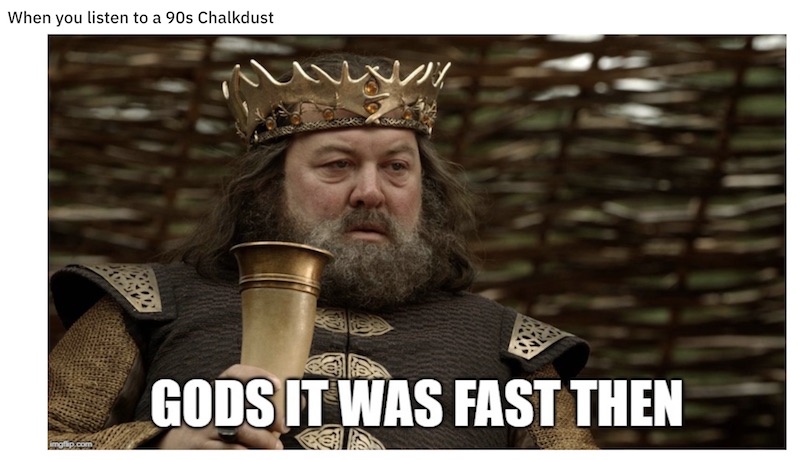
Reddit user FiveDozenWhales, armed with his degree in psychoacoustics and acoustic design (as he told me in a message), thought he would test the theory and perhaps find out why.
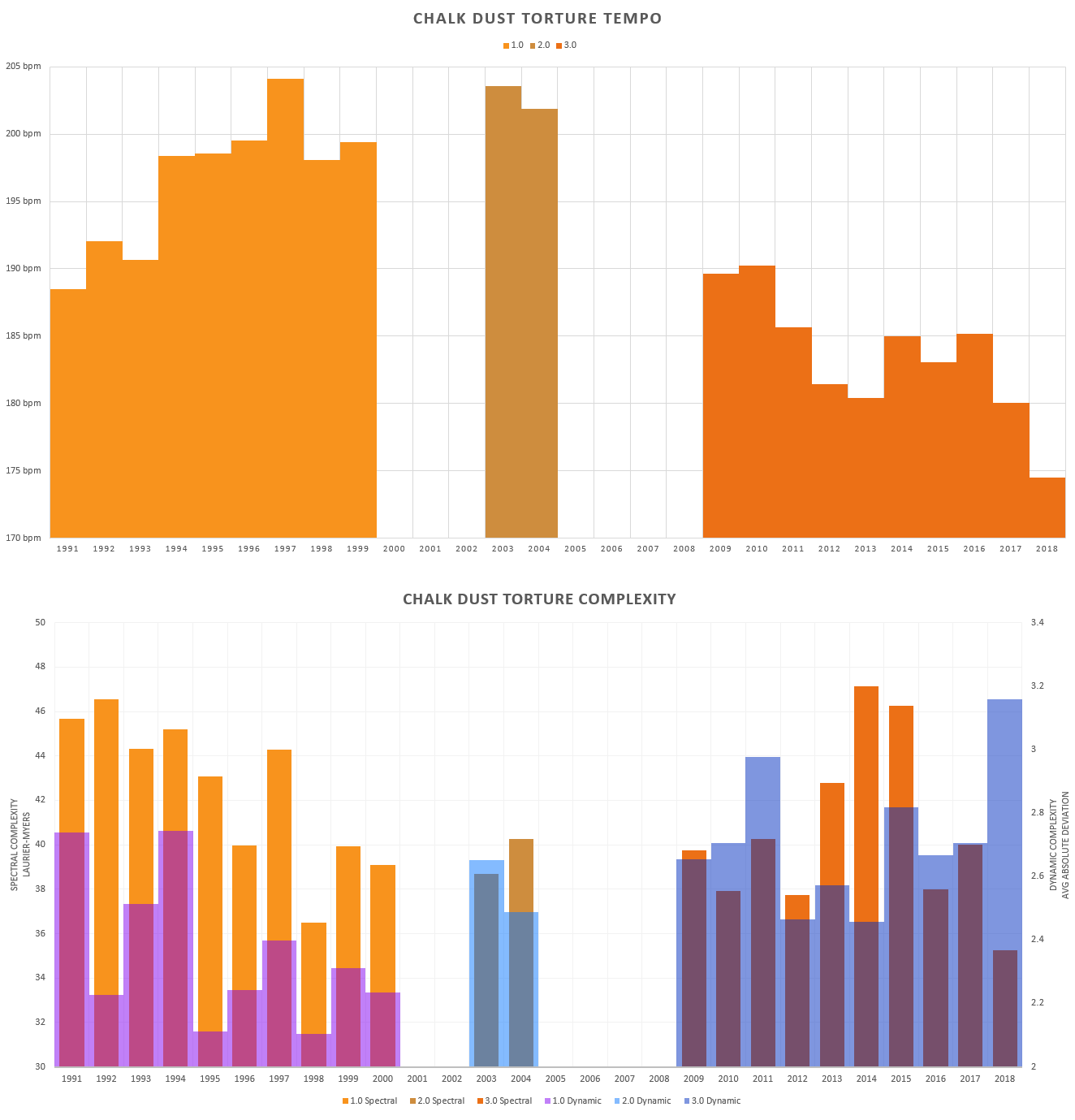
He found that while the song’s tempo increased steadily in the 1.0 years, it’s decreased just as steadily here in 3.0.
But there’s something else going on!
While 1.0 CDT was, musically, a lot of notes, it was never really dynamically complex — which is another way of saying it didn’t have the soaring peaks and soft, swampy valleys the 3.0 versions so frequently deliver.
From FiveDozenWhales’s analysis of the 90s:
The band (probably mostly Trey) is just going nuts, hitting every key possible. But the dynamic complexity isn't really there quite as much. They're rocking at the same volume the whole way through, and it's pretty much all Type 1.
Then comes the latter years:
3.0 flips that… They aren't going nuts the way they used to. What's new, however, is insane amounts of dynamic complexity. This is Phish's new, mature jamming style. We don't see as much machine gunning, but we do have long quiet passages juxtaposed with noisy ones.
CDT has gone Type 2.
Behold, a chart*!
*used with permission
I reached out to our analyzer to ask of a few examples he might share that illustrate the points.
His favorite versions: “Baker's Dozen CDT and Camden '99 are obvious candidates for favorites, but I love teases and segues so 11/27/98 Wipe Out -> CDT -> Wipe Out -> CDT -> Mirror in the Bathroom -> CDT -> Dog Log -> CDT -> Sanity might be my fave. SBD release on LivePhish for that show, too!”
When they truly took it Type 2: “Phish experimented with the type 2 CDT in the late 90s, and even more so in 2.0. But it wasn't until 2014 when it became a regular thing, so I'd put the solid turning point there (or rather on 12/30/2013 if you wanna put a real fine point on it - fantastic, long CDT in the 2-1 spot set the new tradition).”
So, what contributed to the slowdown: “I think CDT has slowed down a lot because it's got complex composed guitar parts and is super-high energy even at a slower pace. I've done another tempo analysis on AC/DC Bag which showed that they're actually playing it at late-90s speed, so Phish hasn't slowed down across the board. It's a slower song though. I honestly don't think tempo affects jamming a lot, at least not directly. There are CDTs where they drop the energy heavily while maintaining tempo. I do think that a song which starts high-energy like CDT takes a little more finesse to steer into a long type-2 jam... Phish didn’t quite have that finesse in the 90s, which is why it took until now to see these long varied jams.”
I also asked he explain spectral peaks a bit further because my mind was exploding.
Here’s what he said:
Spectral peaks are places in the sound where a specific frequency is much louder than those around it - basically, any note played will be a spectral peak, along with some other stuff like a kick drum (cymbals not so much - they're very noisy, there's no specific note peak). The Laurier-Myers algorithm to analyze spectral complexity is basically a way of taking a list of those peaks and determining how complex they are. A fire alarm going off has a lot of beeps happening fast, but they're all at the same frequency and happening at a regular rhythm - not very complex. Trey machine gunning and playing triplets while Mike is playing something syncopated - very complex.
Click or tap these links for more from FiveDozenWhales: Song length by tour, Mike's Song : Weekapaug Groove Ratio, Average speed of AC/DC Bag, by year, In shows with a Tweezer, when did Tweezer Reprise get played?, and Odds of Tweeprise placement for Set 1 / Set 2 Tweezers.
The Shakedown
“King Weir”: Brett Martin profiles Bobby Weir for GQ — a man who just won’t stop. “That's the gig. That's what I'm here for. I'm here to light people up.”
On song selection: Check out this real-life setlist from Trey’s Tuesday night in St. Petersburg, Florida. Now compare it to how things played out. Stay loose!
Maxed out: The psychedelic artist Peter Max is not doing well and things are bad: “The twilight years of Mr. Max’s life have produced a pursuit of art-auction profits and a trail of misfortune as surreal as his trippiest works.”
Must-listen podcast: Tom Marshall, his daughter Anna & RJ Bee have an incredible new Under the Scales episode that dives deep into lyrics Tom helped pen, including Scents & Subtle Sounds, Joy, Steam, Walls of the Cave, Joy and Pebbles and Marbles. It’s a reprise of this deep dive. It’s also a heart-tugger if you’re a parent.
Bass bombs away: Mike previewed his bass rig, saying he wants to get to a place where everything’s the same for all his bands — but he’s not there yet. He’s headed to Red Rocks on Saturday night alongside White Denim & moe.
Spinning: A record store in Alabama claimed on Twitter that a “Slip Stitch and Pass” black vinyl reissue is coming THIS FRIDAY. I don’t know anything more than that but @Phish liked the tweet!
Tweeter Reprise
*POP QUIZ ANSWER: The "Reverend" Jeff Mosier joined the band! He’s responsible for teaching the boys some bluegrass, and shot an incredible homemade documentary called the Bluegrass Sessions about those days that’s most certainly worth your time.